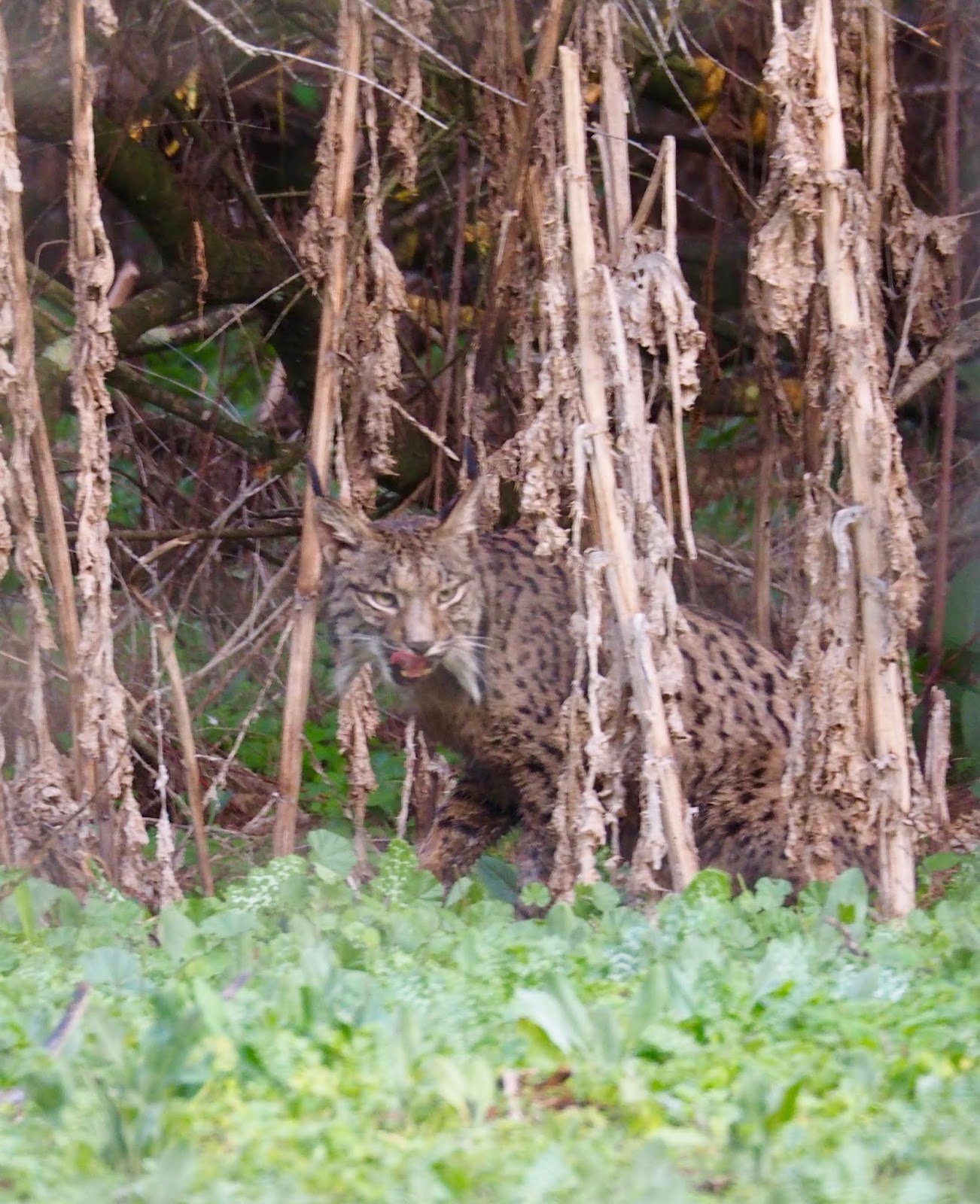
This week I've received the following photos from José Manuel, my lynx-tracking friend in Doñana, of Jasper, the two-year-old male Iberian lynx we saw together a few days ago.
Jasper the week before I saw him
by José Manuel Bernal
Jasper as I saw him last week
by José Manuel Bernal
Jasper licking his paws after a rabbit breakfast
by José Manuel Bernal
Jasper as he left us
by José Manuel Bernal
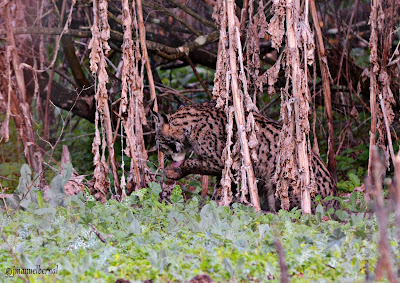
I've also heard from Amith, my co-leader in Satpura, now working his first season in Dudhwa in North India. He kindly sends these evocative images of tigers he has recently seen there and (oh Amith, didn't you hurt me enough with the rusty-spotted cat photo?) of a fishing cat he saw. there too. There is no fishing cat on my list but I am thrilled my talented friend has seen one.
Tiger in Dudhwa by Amith Bangre
Tiger in Dudhwa by Amith Bangre
Fishing cat in Dudhwa by Amith Bangre
(Don't just send me one; show me one!)
Good news from Tadoba in Central India, from where my friend Chirag Roy, a gifted naturalist and communicator at Svasara (also rescuer of cobras and spotter of rusty-spotted cats), sends these photos of Maya. On 5th March she became the first of the 13 tigers I saw in India this year. She's seen here with her three growing cubs, result of her dalliances with Tadoba's male tigers in the spring. Thank you Chirag for the news and your photos; thank you to the people of Tadoba for protecting this beautiful young family; and thank you Maya, just for being you.
This morning I gave a talk on cat conservation for my friend Jerry Kinsley's students at Easton College. I chortled, driving there, to see this on the crazy golf course just outside the college gate.
This is not, in fact, the only tiger I've seen in Norfolk this year. In the summer I had a fascinating meeting with Mike Woolham, animal manager at Banham Zoo, about the zoo's commitment to engagement and education. I took the opportunity to get friendly with their Amur tigers, who competed to out-selfie the Highland Wildlife Park's Amur tigers in the spring.
Highland Wildlife Park Amur tiger selfie
Banham Zoo Amur tiger selfie
On the same day I pushed the boundaries of cat selfies, achieving them (with mixed success) with Southern African cheetah, Sri Lankan leopard, ocelot, snow leopard and Pallas's cat.
I'm ashamed not to have written up the many things Mike generously shared with me that day. I have been meaning to ever since but have simply not had time. Yesterday in the Norfolk Wildlife Trust office my very good friend Rebecca, head of PR and communications at NWT, said that she'd wondered why I hadn't written more about cats during the summer and autumn. Then she'd realised that it was she who was to blame.
She's not personally to blame, of course, but there is much truth in what she says. Most of my time in the UK this year has been devoted to helping produce a publication celebrating 90 years of Norfolk Wildlife Trust, which is now on sale.
The rest has been spent working on a series of short films about Norfolk Wildlife Trust's Living Landscape projects, which has been airing over the past six weeks on Mustard TV. The last episode, on the Cley to Salthouse Living Landscape project, will go out tomorrow night.
So yes, in a way, Rebecca is responsible for my not writing nearly as much about cats as I had planned (though I have described every one of the 164 cats I have seen in the wild). As 2015 ends, she and I have embarked on an ambitious project for NWT's coming anniversary year, so it's unlikely I shall have much more time for cats. I shall write up what I learned at Banham, as Mike was kind enough to meet me and share his experience and knowledge, and I hope one or two other ideas will make it to my blog.
For now I'm writing an article for the EDP Norfolk Magazine and tomorrow I shall be at Mustard TV, for the last film in our series, and to talk about Jasper the Iberian lynx I saw last week in Spain.
It's a funny old life, but a good one. And my work and journeys this year, with cats and without them, and with your company and support, have been an honour and a delight.
My generous client Lance Tuckett (who has spent five weeks of this year watching Asiatic lions, pumas, jaguars and Iberian lynx with me) has been kind enough to send these images of Jasper the lynx, whom we saw last week, licking his lips after his rabbit meal. Thank you Lance; it has been a pleasure watching cats with you.
The Iberian lynx is now - quite rightly - held dear by the people of Andalucía and is prominent in art, tourism and education, especially in Doñana and Andújar. Here then are a few of many lynx-related images and experiences from the ten days I've just spent in the south of Spain.
Iberian lynx tile in the Hotel Toruño, El Rocío
Lynx footprint in the Raya Blanca, Doñana
Lynx footprint in the Raya Blanca, Doñana
Eucalyptus stumps arranged in a corral, to create good breeding habitat
for rabbit colonies (essential for lynxes) and protect them from
predation of kittens by wild boar
Iberian lynx conservation poster
Iberian lynx (and mallard) carving
at La Rocina
Lynx habitat at La Rocina
Lynx track interpretation at La Rocina
Ladder of trunks to help lynx (and other animals)
get over roadside fences near Matalascañas
Caution Lynx Crossing sign in Doñana
Lynxes on a plate at Hotel Toruño
Naturetrekkers searching for lynx
in Andújar Natural Park
Caution Lynx Crossing sign
in Andújar Natural Park
Today was emotionally charged for everyone on our tour, and it has ended in the Sierra Morena where tomorrow we go to the hills in search of lynxes and other wildlife. Reaching a wifi signal tonight I received from my friend and colleague José Manuel Bernal these photos of Jasper, the lynx we saw first thing this morning, and of the four guides on our tour: Sergio, José Manuel, Byron and a marsh tit.
I've been in Doñana now for almost a week. That's almost a week with no lynx. The four days I spent here with my dear friends DTH and Roger were dogged (emphatically not catted) by bad luck and we saw little (if black and white storks, cranes, booted eagles, Spanish imperial eagle, white-headed duck, bluethroats, penduline tits, griffon vultures and a locally very rare red-breasted flycatcher can be described as little). In the two days since our Naturetrek group arrived we have worked very hard, spending long hours in the field from dawn until dusk, seeing nothing, Nothing, at least, with ear-tufts and black-lined lamb chop whiskers.
This morning we broke from protocol, deviated from our itinerary (nature tour-leading bad boys that we are), taking a risk and visiting Doñana again, instead of heading to the mountains. As we crossed the park boundary, our first vehicle, driven by our talented local guide José Manuel, sped up. In our vehicle, driven by my friend of many years Byron Palacios, we did the same. A lynx slipped at speed through distant tamarisks, bearing in its mouth a rabbit. Through the park fence it wove with its prey and was gone. Our front vehicle had seen it briefly but well. Our second, with Byron and me, had seen it briefly and not at all well. One client quietly said that she had seen that it wasn't a wild boar. When clients can only say that rare target animals weren't boar, leaders' hearts sink. So I'd glimpsed a damp lynx in the dew and the dawn. José Manuel, who knows these lynxes as almost no-one else, decided we would leave him (him: it was a two-year-old male known as Jasper) to eat his rabbit. So we left and followed the same sandy figures of eight through the park, one vehicle elated, the other trying to be. We came back and saw nothing, peering in hope into every bush. As we moved again José Manuel stopped and waved frantically to our vehicle. There in the open at the edge of a tamarisk clump, just a few metres from us, was Jasper, fastidiously licking his paws. He licked and he shook and he looked directly at us, his olive eyes staring from his strange, whiskered face. Then he walked, left flank towards us, into the scrub, his short tuft of a tail lost last among the tamarisk, For the rest of the morning, on our bad-boy last stand in Doñana, we watched cranes and crested larks, zitting cisticolas and fallow deer, and we gossiped and beamed, our lives crossed by the world's rarest cat, the 164th cat of 13 species on my Big Cat Quest and most probably the last.
Cats seen in 2015
cheetah Acinonyx jubatus fearonii 3
serval Leptailurus serval serval 3
leopard Panthera pardus suahelicus 2
lion Panthera leo nubica 78