Monday, 7 December 2015

Lance's lynx


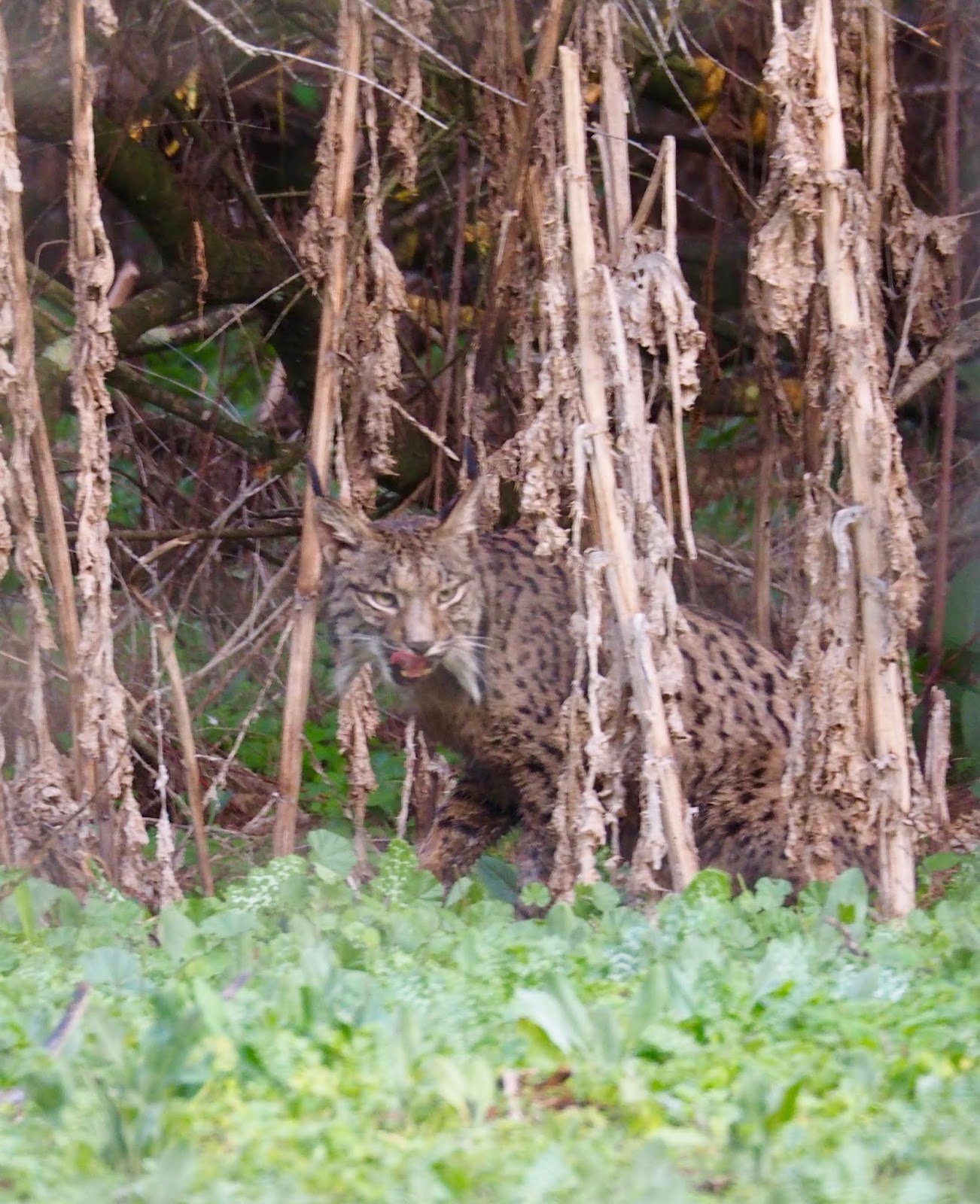
My generous client Lance Tuckett (who has spent five weeks of this year watching Asiatic lions, pumas, jaguars and Iberian lynx with me) has been kind enough to send these images of Jasper the lynx, whom we saw last week, licking his lips after his rabbit meal. Thank you Lance; it has been a pleasure watching cats with you.


Iberian lynx Jasper by Lance Tuckett


Saturday, 5 December 2015

Lynx lore


The Iberian lynx is now - quite rightly - held dear by the people of Andalucía and is prominent in art, tourism and education, especially in Doñana and Andújar. Here then are a few of many lynx-related images and experiences from the ten days I've just spent in the south of Spain.


Iberian lynx tile in the Hotel Toruño, El Rocío

Lynx footprint in the Raya Blanca, Doñana

Lynx footprint in the Raya Blanca, Doñana

Eucalyptus stumps arranged in a corral, to create good breeding habitat
for rabbit colonies (essential for lynxes) and protect them from
predation of kittens by wild boar

Iberian lynx conservation poster

Iberian lynx (and mallard) carving
at La Rocina

Lynx habitat at La Rocina

Lynx track interpretation at La Rocina

Ladder of trunks to help lynx (and other animals)
get over roadside fences near Matalascañas

Caution Lynx Crossing sign in Doñana

Lynxes on a plate at Hotel Toruño

Naturetrekkers searching for lynx
in Andújar Natural Park


Caution Lynx Crossing sign
in Andújar Natural Park


Tuesday, 1 December 2015

Jasper


Today was emotionally charged for everyone on our tour, and it has ended in the Sierra Morena where tomorrow we go to the hills in search of lynxes and other wildlife. Reaching a wifi signal tonight I received from my friend and colleague José Manuel Bernal these photos of Jasper, the lynx we saw first thing this morning, and of the four guides on our tour: Sergio, José Manuel, Byron and a marsh tit.


Jasper by José Manuel Bernal

Four guides post-lynx

Lynx-branded wine


Lince


I've been in Doñana now for almost a week. That's almost a week with no lynx. The four days I spent here with my dear friends DTH and Roger were dogged (emphatically not catted) by bad luck and we saw little (if black and white storks, cranes, booted eagles, Spanish imperial eagle, white-headed duck, bluethroats, penduline tits, griffon vultures and a locally very rare red-breasted flycatcher can be described as little). In the two days since our Naturetrek group arrived we have worked very hard, spending long hours in the field from dawn until dusk, seeing nothing, Nothing, at least, with ear-tufts and black-lined lamb chop whiskers.

This morning we broke from protocol, deviated from our itinerary (nature tour-leading bad boys that we are), taking a risk and visiting Doñana again, instead of heading to the mountains. As we crossed the park boundary, our first vehicle, driven by our talented local guide José Manuel, sped up. In our vehicle, driven by my friend of many years Byron Palacios, we did the same. A lynx slipped at speed through distant tamarisks, bearing in its mouth a rabbit. Through the park fence it wove with its prey and was gone. Our front vehicle had seen it briefly but well. Our second, with Byron and me, had seen it briefly and not at all well. One client quietly said that she had seen that it wasn't a wild boar. When clients can only say that rare target animals weren't boar, leaders' hearts sink.

So I'd glimpsed a damp lynx in the dew and the dawn. José Manuel, who knows these lynxes as almost no-one else, decided we would leave him (him: it was a two-year-old male known as Jasper) to eat his rabbit. So we left and followed the same sandy figures of eight through the park, one vehicle elated, the other trying to be.

We came back and saw nothing, peering in hope into every bush. As we moved again José Manuel stopped and waved frantically to our vehicle. There in the open at the edge of a tamarisk clump, just a few metres from us, was Jasper, fastidiously licking his paws. He licked and he shook and he looked directly at us, his olive eyes staring from his strange, whiskered face. Then he walked, left flank towards us, into the scrub, his short tuft of a tail lost last among the tamarisk,

For the rest of the morning, on our bad-boy last stand in Doñana, we watched cranes and crested larks, zitting cisticolas and fallow deer, and we gossiped and beamed, our lives crossed by the world's rarest cat, the 164th cat of 13 species on my Big Cat Quest and most probably the last.


Cats seen in 2015
cheetah Acinonyx jubatus fearonii                3
serval Leptailurus serval serval                    3
leopard Panthera pardus suahelicus            2
lion Panthera leo nubica                              78
snow leopard Panthera uncia                       3
jungle cat Felis chaus                                   2
tiger Panthera tigris tigris                            13
leopard Panthera pardus fusca                    4
lion Panthera leo persica                              7
leopard cat Prionailurus bengalensis           15
flat-headed cat Prionailurus planiceps          1
wildcat hybrid Felis silvestris grampia/catus  1
jaguar Panthera onca                                    17
puma Puma concolor                                    14
Iberian lynx Lynx pardinus                            1


Tuesday, 24 November 2015

Missing lynx: an alternate view


You may recall that in January my young friend Anna helped me with wildlife identification in Tanzania. Today my delightfully creative, wood-carving, stone-inscribing, quilt-making, paper-folding friend Sarah sent me this, part of a clever card she made in a moment which folds four ways to reveal four cats.


Iberian lynx by Sarah Ruffle

Thank you Sarah. Now I shall know what one looks like.


Missing lynx


I don't remember which of my clients in South America recently suggested the title of this post. Whoever it was, I'm grateful. For the Iberian lynx, indeed lynxes in general, are missing from the list of cats I have seen during this marvellous year.

So far that is. By next week I hope this situation will have been rectified. Today I am off to London to stay with my great friend Gavin and eat at his local Indian restaurant where three weeks ago he took this photo of me with its highly distinctive tiger.


Tomorrow morning Gav's dad DTH, our old friend Roger and I are bound for Seville and Doñana, there to search for the Iberian lynx for three days (before the arrival of a week-long Naturetrek tour, also in search of this rarest cat in the world, led by my Ecuadorian friend Byron Palacios with a little help from me).

To get you in the mood for lynx-watching (lynx-watching I hope, lynx-searching at the very least) here are some photos taken last year in Doñana by my friend Chris Hutchinson who, with Christine, was with me last month in Chile and Brazil, watching pumas and jaguars. Finally, here too is a photo taken last Wednesday in Doñana by my new colleague, Byron's friend José Manuel Bernal, who will be instrumental in our search for the cat there.

It is a spectacular cat indeed. Wish me luck.


Iberian lynx by Chris Hutchinson

Iberian lynx by Chris Hutchinson

Iberian lynx by Chris Hutchinson

Iberian lynx by Chris Hutchinson

Lince ibérico por José Manuel Bernal

Monday, 23 November 2015

Friends far and friends feline


It is winter. Hail on the ground and a cold gloom to the sky. A grey wagtail's sharp note cuts the dull day and the cold cuts my fingers.

On the other side of the world, I imagine, winter's grey wagtails twist between the rocks of Indian streams; streams in which tigers live their lives.

I have heard this week from several tiger friends in India, with news of tigers I know, of other cats, of new adventures. I'm off to Spain tomorrow, in search of my last new cat of this Big Cat Quest of mine, so today it is good to reflect on the cats I have seen all year and the sun-hearted people with whom I have shared them.

I hear from handsome, ever-smiling Omi (Omveer Choudhary), who works at Tuli Tiger Corridor where I always stay in Pench. Our friend Collar Wali, the thirteen-year-old mother of more cubs than any other recorded tigress, is well. She has lost two cubs from the litter of four to which she gave birth just days after I saw her in March, but the other two are well. Omi sends these photos of Collar Wali, taken during a superb encounter with her last week.


Collar Wali by Omi Choudhary


So too I hear from my great friend Chirag Roy at Svasara in Tadoba, and with the best of news. P2 or Maya, whom I saw several times there in March, who was indeed the first of the thirteen tigers I saw this year, has cubs. Chirag writes that a couple of days ago he saw her three cubs for the first time, at four-and-a-half months old, as she brought them to a sambar she had killed. No-one knows who the father is as, wisely, while I was in Tadoba in March, Maya was frequenting several males, allowing each of them to believe he would be father.


Maya and cubs by Chirag Roy


My kindly, brilliant friend Amith Bangre, with whom I watched sloth bears and the leopard-that-broke-my-toe in Satpura in late March, has moved to Dudhwa, home of nominate barasingha and greater one-horned rhinos, in the Himalayan foothills close to the border with Nepal. Here he has been seeing tigers and (how to make me jealous, Amith) has seen a fishing cat.


Tiger in Dudhwa by Amith Bangre


As if that weren't enough Amith sends these gorgeous images of a rusty-spotted cat (also absent from my Big Cat Quest) from his days in Satpura, and of Nilu the astonishing blue-eyed leopard, frequently seen last season in Satpura with his yellow-eyed brother Pilu (sons, as it happens, of leopard-that-broke-my-toe).


Leopard hunting by Amith Bangre

Peacock's back by Amith Bangre

Rusty-spotted cat by Amith Bangre

Nilu by Amith Bangre


Staying with blue-eyed cats, I confess an indulgence. A few months ago my old friend in Bolivia Leoni Manrique held an exhibition in the Amazonian state of Pando. The cover image of his exhibition was an extraordinary close-up of a jaguar's face, quite unlike any of his previous work I'd seen. I knew I had to own it and, though I had not yet seen jaguars, it seemed a fitting memento of my Big Cat Quest. I sheepishly wrote to Leoni asking whether it was for sale, whether he would sell it to me, whether we could find a way of getting it to the UK. He replied to say that the painting meant much to him, that it represented a new phase in his work, that he would love me to have it for all that we had experienced together in Bolivian Amazonia. So we looked into sending it to the UK and hit a stumbling block: buying it, sending it and mounting it again would cost more than I could possibly afford. Stalemate. Then it dawned on me that soon I would be in Brazil. So Leoni sent it to me in the Pantanal at a fraction of the cost, I brought it home and I took it to be mounted locally. Today I collected it. And I love it, deeply, as I have loved every cat this year, their offspring in the far forests, and the friends with whom I have watched them.


Leoni's painting as I saw it online and fell in love with it

A Bolivian painting, sent to Brazil,
being framed in North Norfolk

At home, where it belongs. Thank you Leoni.