Friday, 13 February 2015

Who's who: India


Asia is where the cats are. Counting (as discussed previously) the Chinese mountain cat as a subspecies of the wildcat, Asia is home to twenty of the world's thirty-six species of cat. Twelve of them are found in Asia alone.

One country, because of its size and its huge range of habitat and altitude, has more cats than any other: India. In this wonderful place, there live no fewer than fifteen species of cat, with a sixteenth, the cheetah, having been hunted to extinction as recently as the 1960s.

From next week, I shall be in India for two months, visiting some of its most spectacular and cat-blessed regions. I shall not, however, be in the humid forests of northeast India this year, so I will have no chance of seeing the Asian (Indochinese) clouded leopard, the Asiatic golden cat or the marbled cat. I shall also be out of the Indian range of the fishing cat, which lives in the wet grasslands and forests of the Gangetic Plain, eastern India and the northeast. Finally, I have effectively no chance of seeing the world's smallest cat, the rusty-spotted, or indeed the leopard cat. Both of these species are found in central India, where I shall visit four parks, but they are nocturnal and night drives are forbidden. Night walks in tiger country are generally considered foolish.

(In Borneo in April, however, I have an excellent chance of seeing leopard cats and a slim chance of meeting a marbled cat. But more on that anon.)

The cats whose ranges I shall visit in India this year, several of which I would be staggeringly lucky to see, are these:

Pantherinae

Snow leopard Panthera uncia

The snow leopard occurs sparsely over a huge range in twelve countries of Asia. Most associated with high mountains, and found at elevations up to 6,000m, in many areas snow leopards move to relatively lower elevations in winter, driven by deep snow on the mountaintops and the altitudinal migration of their sheep and goat prey. They are superbly adapted for their environment, with excellent camouflage, huge paws for walking in snow, expanded nasal cavities to warm mountain-cold air, and very long tails for balance in precipitous terrain and for use as mufflers around their noses as they sleep. Mating occurs from January to March and - here's the reason we look for them in February - is accompanied by a spike in diurnal activity and vocalisation. Cubs are born high in the mountains in summer, after a gestation of around 100 days. Through conflict with humans and their livestock and the gradual development of its remote habitat, the snow leopard is threatened across its range. Between four and six-and-a-half thousand snow leopards are thought to exist in the wild and the species is classified as endangered by the IUCN.

To behold a snow leopard is to understand the beauty of nature, to treasure it, and to fight for its survival.

George Schaller
Tibet Wild - A Naturalist’s Journeys on the Roof of the World


Snow leopard in Ladakh, February 2014.
Image by Kenny Ross.


Tiger Panthera tigris

The tiger is likewise endangered, though three of its surviving subspecies are critically endangered. Three other subspecies have recently become extinct. Throughout its range, during the nineteenth and early twentieth centuries, the tiger's habitat was destroyed, and the species itself was systematically eradicated. Remaining populations are under severe threat from poaching for skins and quack medicines.

In India alone it is estimated that in 1900 there may have been 40,000 tigers. Today, inasmuch as anywhere is a stronghold for this beleaguered, beautiful animal, it is India still. Recent news is encouraging. In 2008 the census of Indian tigers found an estimated 1,411. Census data released in late January 2015 suggest the country may now hold as many as 2,226. The world population is thought to be between 3,200 and 4,000, making India critical for the tiger's global survival.

Perhaps the most striking and instantly recognisable of cats, the tiger exercises great power over the human psyche. It is nonetheless surprisingly varied across its range, with great differences in size between the huge Amur and squat Sumatran subspecies; and considerable difference in coat colour and stripe pattern too. Predictably, across the once vast range of this great cat there is also tremendous variation in habitat and prey. In central India, where we shall be looking for tigers (and it has been my privilege to see them many times in the past decade) their chief prey are deer, including chital, sambar and barking deer, and wild boar and gaur.


The male tiger Munna in Kanha National Park in November 2008.
He is readily recognised by having CAT written across his forehead.
This was the first time I met him; subsequently I saw him many times
until March 2012 when I was last in Kanha. In summer 2014 I heard he was well.
Image by Anne-Marie Kalus.


Leopard Panthera pardus

We know the leopard already from Tanzania. Whereas in Africa it occurs beside the lion, in much of India it lives in the shadow of the tiger, though, to a much smaller extent, the lion is found here too. While widely persecuted, leopards have survived near people more successfully in India than tigers, with urban leopards reported not infrequently and cases of leopards hunting dogs and livestock in rural villages still common. Leopards range in India from semi-arid regions at the edges of deserts to dense humid forests in the southwest and northeast. They are found at sea level and up to 3,000 metres of altitude in the Himalayas. Over this range they prey on many species including peafowl, deer, antelopes, monkeys and small mammals.

Those who have never seen a leopard under favourable conditions in his natural surroundings can have no conception of the grace of movement, and beauty of colouring, of this the most graceful and the most beautiful of all animals in our Indian Jungles.

Jim Corbett 
Man-Eaters of Kumaon


Leopard in Pench National Park, November 2008.
Image by Anne-Marie Kalus.

Lion Panthera leo

Lions once occurred widely across northwest and central India, in generally drier, spinier habitats than those favoured by the tiger. Their range stretched from here to Iran and Iraq. Today, alas, Asian lions are found only in the Gir Forest in the west of Gujarat where they persisted almost by accident. Here in one fragile park there are around 350 cats, all descended from fewer than twenty which existed in 1900. Their habitat is restricted and they come into frequent conflict with humans, especially as they regularly hunt cattle and buffalos.

Physically Asian lions are very similar to African, though a hairy flap of skin hangs from the males' bellies and their manes are often less dense.


Felinae

Caracal caracal caracal

The gorgeous caracal is largely African and Middle Eastern but reaches the extreme eastern limit of its distribution in northwest India. In Gujarat I will be within its range but it is very unlikely I will see one.

Cross your fingers people.

Eurasian lynx Lynx lynx

It is equally unlikely I will see a lynx. This hugely widespread cat reaches the southernmost limit of its distribution in the high Himalayas. It occurs in Hemis National Park, Ladakh, in the areas in which I will be looking for snow leopards. However, my colleagues there report having seen it very few times in their lives, most often in their home villages. The Eurasian lynx is the only one of the four species in the genus Lynx which is not a specialist hunter of rabbits and hares, generally preferring small ungulates. The identifying features of the lynx are its bob tail, its black ear tassels and the thick pointed sideburns which frame its face.

Pallas' cat Otocolobus manul

Pallas' cat, also known as the manul, is a squat, densely-furred mountain cat with a broad, flat face and small ears to avoid heat loss. It occurs over a large area of montane Asia, hunting small animals such as pikas, hares and chukar. It is found in the extreme north of India, in the region in which I will be looking for snow leopards, but is only exceptionally seen here.

Jungle cat Felis chaus

Jungle cats are similar in shape to domestic cats, though larger and rangier with relatively big ears. Their stripes are restricted to their shanks and tails and the rest of the coat is golden-grey or brown. They occur widely from Egypt, through parts of the Middle East and southwest Asia, to the Indian Subcontinent and southeast Asia. The jungle cat is most associated with grassland, wetland and scrub, rarely using tall forest. Mainly a hunter of small mammals, across its huge range it also takes reptiles, birds, fish and insects. I have many times seen the जुंगली बिल्ली in central India and have excellent chances of seeing one again in March.

Wildcat Felis silvestris

The last cat which I might encounter on my Indian travels is the wildcat, in this case the Asian or desert subspecies Felis silvestris ornata. In India wildcats are found only in the northwest, covering a similar range to the caracal; I will be in good habitat for them in parts of Gujarat.

Keep those fingers crossed, people. Keep those fingers crossed.

Thanks to my friends Anne-Marie Kalus and Kenny Ross for the use of the beautiful photos they took watching cats by my side.


Monday, 9 February 2015

Fame for all the wrong reasons


Today I made a Big Cat Quest appearance on The Mustard Show (Part 2 here), in addition to filming a piece on the Hawk and Owl Trust's Norwich Cathedral Peregrine project, which will be screened soon. In promoting today's interview on Twitter Mustard made a tiny orthographic error.

I'm happy with either.


In more serious news, two pieces I recently filmed with Mustard TV on Norfolk Wildlife Trust's land acquisition to complete the Cley to Salthouse Living Landscape and the construction of the Simon Aspinall Wildlife Education Centre may be found here and here.

And last week I was being taught to dance by the Maasai. It's a funny old life.

A marsh tit among Maasai by Lin Arney


Saturday, 7 February 2015

The marsh tit and the lions


Last night a lovely Tanzania tour client sent me these photos of a marsh tit and friends in Ngorongoro.

A marsh tit in Ngorongoro by Lin Arney


The aim of my Big Cat Quest has always, since I conceived it last year, been to support projects around the world which benefit cats, their habitats and the people whose lives are affected by them. I was therefore extremely touched to be told by my group as we left Tanzania that, quite unprompted, they had decided on my behalf to make a donation to the Serengeti Lion Research Project. If you have an hour, it is greatly worth watching this video of Dr Craig Packer the project head, on his team's discoveries on lion sociality in relation to habitat, the evolution of males' manes, and the grave threats faced by lions as a result of conflict with humans and their livestock, including the tragic persistence of man-eating and the mismanagement of trophy hunting. Their findings are striking and most alarming. Two messages worth keeping are that lions have declined to 30,000 individuals occupying just 18% of their historic range; and that half of Africa's surviving lions are understood to live in Tanzania.

Dr Packer highlights the fact that in the Developed World we perceive lions as easy to preserve and their conservation an obvious moral obligation: 'But you go to Africa, where lions live, where lions are abundant, and you get a very different picture. The lion is something to be destroyed; the lion is something that needs to be removed. Lions are one of the most hated species in Africa. Lions should all be dead.' There will be more here on conflict between cats and people in the months to come.

Of particular, and more positive, interest is the remarkable citizen science project Snapshot Serengeti, which may be found on Twitter here, in which members of the public all over the world help analyse camera trap data from the Serengeti and thereby contribute to the work of the Serengeti Lion Research Project.

Long may you roam there.


Friday, 6 February 2015

Cobwebs


Yesterday from the train between Downham Market and Littleport I saw six Egyptian geese fly from the Great Ouse. I had seen the same species the day before in Tanzania. I liked this symmetry, as wildlife is one of the gossamer strands which weave the cobweb of my life: tough but delicate, and intricately beautiful.

The day before yesterday in Tanzania there were many birds along the road, and many more birds and mammals in our minds, as we retreated into ourselves and our thoughts, aware that the gossamer strand of our time in Tanzania must be snapped.

We stopped for lunch at Gibb's Farm, a coffee plantation on the margin of Ngorongoro Conservation Area, with an organic vegetable garden complete with fires to keep elephants away from the bananas by night. Around the restaurant, in which the fruit and vegetables come fresh from the earth, is a beautiful flower garden, inhabited by white-tailed blue flycatchers, bronze sunbirds and golden-backed weavers.


It was here, seeing a leopard design on the restaurant wall and another on a beer bottle, that I began to reflect on big cats as images in our psyche, our advertising and our culture. At Heathrow, where I was stuck for three hours before my off-peak train ticket came into force, I saw another example, promoting The Lion King. The last is from King's Lynn station where my father was kind enough to meet me at the end of a long journey.


What big cats, and small, mean in the cobweb of human lives, as neighbours, as enemies, as victims, as subjects of research, and as symbols, will surely be a common theme in my writing in the coming months. Now though, I have but two weeks to prepare for three months in Asia, and I am happy to be, very briefly, home, and to see that Tarquin and Amanda, the two call ducks dumped with the muddled mallards on the pond outside my house last autumn, are well.


Mbuzi Mawe, Serengeti. Sticking with The Lion King theme:
'Everything the light touches is our kingdom.'


Wednesday, 4 February 2015

Tanzania


Last night we were welcomed into the homes of the smiling, dignified Maasai people who live in the Ngorongoro Conservation Area. As their boys came home in the evening from the hills, a serval bolted from cover ahead of them. The wild cats of Tanzania stay with me until the last.

This has been a stolen season here; a dream of the greatness and beauty of Tanzania. And the greatness and beauty of her cats. Wherever we have been, we have been welcomed with kindness and good humour. And wherever we have looked we have seen beauty.

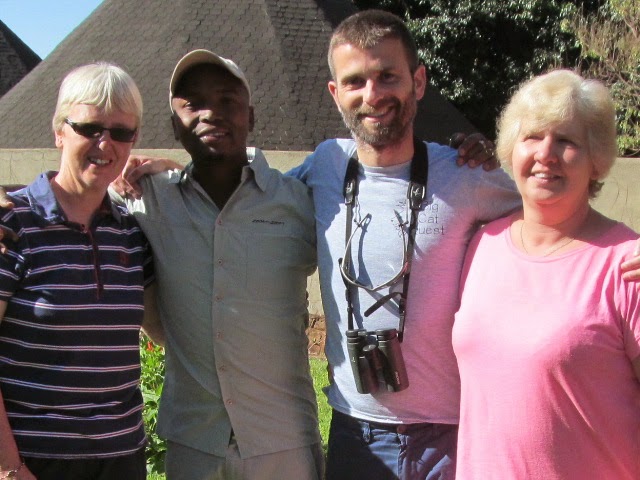
Pivotal in our experience have been Richard and George, our driver-guides, now friends. Their knowledge and love of their country, its people and wildlife, have been shared with clarity, with compassion and with humour. Working by their side has been an honour. An honour I hope to repeat.

For now, jeeps, airports, planes and, I'm told, snow.


Richard

George


Tuesday, 3 February 2015

78


Seventy-eight is the number of lions we have seen on our tour as we leave the Ngorongoro Crater. Not seventy-eight sightings, of these there have been many more, for we have seen three prides twice: but seventy-eight individual lions whose paths have crossed ours in the past two weeks. Each has been a joy to us.

Today's lions were numerous, as were the many other creatures of the grasslands of Ngorongoro. We saw cubs, we saw lionesses, we saw superb adult males. The lions which most amazed us were those which late in the morning came to rest in the shade of our vehicles. In such circumstances it is difficult to explain to clients that these perfectly wild animals have a huge landscape in which to rest, to hunt, to drink and to play. However, comfortable with vehicles in their landscape since cubhood, these lions, and tigers in India too, use our jeeps, for shade, for cover and even in the case of Ngorongoro's lions as perches from which to watch. Our jeeps are but another inert, potentially useful feature of their landscape.

Once I'm back in the UK, from my long trip to Asia which begins in two weeks, much more will follow here on lions in Africa and their future. For now, here are this morning's photos of lions using our jeeps to their advantage.


George with lions behind him


There were also extraordinary black rhinos along our way this morning: the sort of encounter of which local guides dream. A mother and her well-grown youngster wandered gently across the plain, towards the track on which jeeps were lined watching. Generally in Ngorongoro rhinos are seen in a distant heat haze, but today they walked alongside our jeeps and crossed the road behind us, allowing each heart present to be touched by the power and tragic fragility of these awesome animals. As with lions, more will follow on black rhinos in Tanzania from the UK soon.


I leave these lions, these rhinos and all the hoofed, feathered and clawed inhabitants of Ngorongoro, feeling richly privileged to have been here. Tomorrow we travel back to Arusha, and from there to the UK.


Monday, 2 February 2015

Flow


All Ngorongoro is one great flow of water, nutrients, genes and energy. It began two or three million years ago with a flow of lava and ash which levelled the Serengeti, birthing the hoof-trodden plains which dominate today.

Water flows from springs in the volcanic rock, feeding permanent wetlands in the Ngorongoro Crater. The grass here is lusher by far than in the Serengeti. Hence animals live here year-round in astonishing diversity and numbers, without the need to migrate.

This water, the energy of the African sun, and carbon from the earth's atmosphere, stored by the grasses on the crater floor, feed tens of thousand of mouths: zebras, elephants, black rhinos, Grant's and Thomson's gazelles, eland, hartebeest and wildebeest, we saw them all today. The wildebeest are calving in the crater now. We witnessed the birth of a toffee-coloured calf at twelve minutes past nine. At eighteen minutes past it took its first haphazard steps around its mother, hemmed in by aunts and their own newborns.


The afterbirths of the wildebeest are too much energy and protein to squander. A golden jackal trotted between the wildebeest mothers, keeping a wary eye on their swinging, defensive horns, on the lookout for spent placentas. Finding one the little jackal began to gorge but was quickly joined by white-backed vultures, a steppe eagle and a marabou. The vultures taunted the jackal which spun snarling in angry circles. Meanwhile the marabou, stained down its neck in blood, pinched the prize and ate it in big-billed gulps. The jackal retreated, but found another afterbirth and the cycle began again. Elsewhere a golden jackal chewed at an Abdim's stork it had killed, one of hundreds of storks which paced the plain between the herds of wildebeest and zebra.


Over the heads of the herds were thousands of barn swallows, diving at flies. These are birds which soon will flow north, with the shovelers, green sandpipers and white storks we saw here, to repopulate Europe for the summer, taking with them the water and sunshine of Ngorongoro.

Two lion kills from last night lay along our way. At the first there were seventeen lions, most now dozing rotundly, the males right by the road. Only a couple of cubs still chewed at the bones of the buffalo which had given its life in the night. Grass become buffalo become lion. As white-necked ravens dropped to the kill one of the cubs took exception and stalked them clumsily through the grass. This buffalo was for lions and not for ravens. Soon though it would be for black-backed jackals, three of which circled hungrily waiting for the last lion to slip into the cool of the creek's shade before taking their tiny share of the great beast.


The other kill was done. Just three lionesses and two cubs from different litters sat in the grass, sated. Around them was a halo of hyenas, each pushing forward in head-hanging hope. Four of the lions moved to the the shade of one of our vehicles and the hyenas quickly covered the area, checking each spot for bloody leftovers to fill their morning bellies.

These spotted hyenas, great cleaners of Ngorongoro, were all over the crater. But they too must be part, in the end, of this flow. For the first time in either Richard or George's years of work, we saw white-backed and lappet-faced vultures squabbling round the ribcage of a freshly dead hyena, its lifeless face grimacing across the savannah. Perhaps it was ill, perhaps it was slain by a lion, perhaps it was kicked by a zebra. The vultures were pleased, however it died: a foe in life become a meal in death.

Just as genes flow from mother wildebeest to slimy, wobbly calf, and energy flows from sun to grass, grass to grazers, grazers to predators, and finally from predators to scavengers and the soil, there is a flow of humans here too. The Maasai, who once called the crater home, still bring down their cattle to water and salt, before flowing again to the rim and their villages. And each day from the rim there come jeeps full of westerners. This, for them, for us, is a once-in-a-life flow: to see the last of great Africa, to watch as lions devour their kill, as a new wildebeest comes into the wild world, and as jackals scavenge the afterbirth, lest its precious energy should go to waste.

Each of us is in our jeeps is humbly grateful to be witness and part of this flow.

Simba selfie