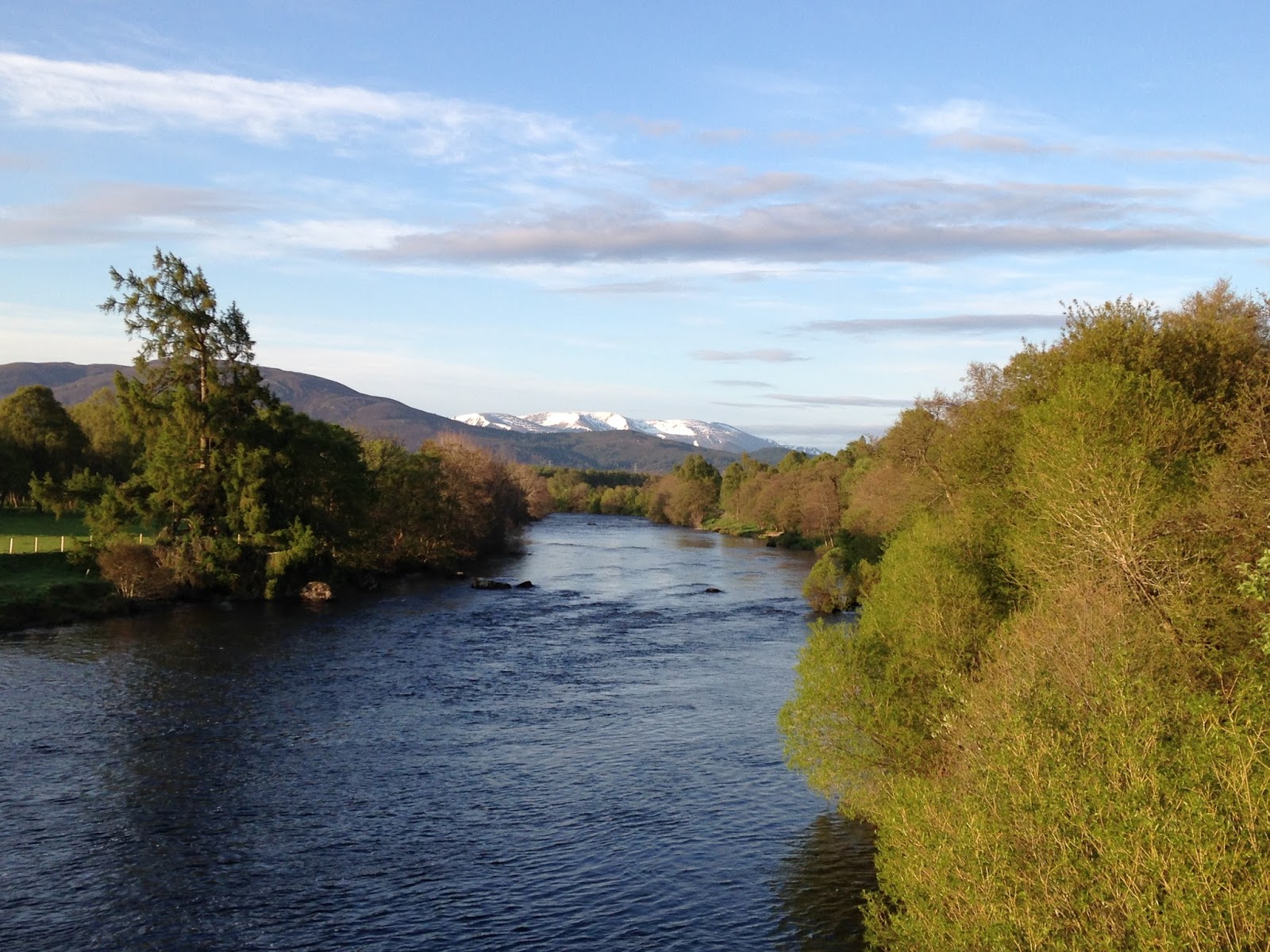
Caledon
After seven cold hours in the field last night and this morning, and with talks to give tonight and tomorrow, after breakfast today I slept for four blissful hours. I woke in the middle of the day and the sun was shining, so I hopped in my car and drove the short distance to Loch Garten.
It must be twenty-five years since I was last here, when, on a family holiday, my parents brought me to see my first osprey. I was spellbound, not just by the osprey, at the same nest as is used today, but by the forest of gnarled, Middle Earth pines with its floor of bright green blaeberry. This was a Britain I had never before seen, an old, wild Britain in which I knew I belonged.
So today's visit was a journey back to a teen self who had yet to see the wide world, who had no idea that he ever would. For whom these returning ospreys and their gnarled forest were a new thrill.
Today they thrill me still. He is there still that wide-eyed teen, enchanted by nature. He has seen more of it than he ever believed possible, but he is still just as thrilled by the world's most watched ospreys and the blush-trunked pines of Abernethy.
 |
| Caledonian pine forest at Loch Garten |
 |
| The closest I came to a capercaillie |
RSPB
I won't hear a word said against the RSPB. Having worked for years with Norfolk Wildlife Trust, The Wildlife Trusts and the Hawk and Owl Trust, I have at times uttered my own words against the RSPB and its occasional moments of bigbrotherishness. But I won't hear a word said against it.
As a huge organisation which affects the lives of millions, it is easy to take a swipe at the RSPB. Two common criticisms levelled are (by birders) that RSPB reserves and facilities are too much aimed at the broader public, and (by other land use stakeholders, including some farmers, some gamekeepers and some readers of the Telegraph) that the RSPB is an over-zealous organisation with a loony, deep green agenda.
The first swipe gets on my crested tits. No one way of relating to nature and wild places has any more validity than any other. There is no parsifalesque chalice of pure understanding bestowed on you because you can identify Caspian gulls in first winter plumage or because you have seen more than 450 species of bird in the UK. You have no greater right to sit in a hide if you've seen a black lark in the UK than if you wouldn't know a black lark if it nested in your petunias.
Nature belongs to, and is belonged to, in equal measure by everyone. And the more of us who love it, who feel an investment in it, whatever form that takes, the greater the chance we have of protecting it. Astonishingly there are those in the birding community who have no great interest in the protection of nature (I recall a recent conversation with a man about the plight of the wildcat in the UK and the only thing which interested him in the slightest was whether he could tick the one he himself had seen as pure), though happily such voices are few. Most realise that without nature reserves there are no birds. No common ones, but also no rare ones. Thinking of the recent spate of rarities in Norfolk, the citril finch enjoyed by hundreds was in Holkham Dunes (protected for its native fauna and flora for many years by Natural England on behalf of the Holkham Estate and now by the estate itself) and the Moltoni's warbler was on Blakeney Point (likewise protected for a century by the National Trust). Without habitat there are no birds, common or rare. And without the support, moral and financial, of millions of people, birders and lay-folk alike, there are no NGOs or statutory organisations to protect habitat. Facilities for exploring such habitat should be open to all in the community, all who love wildlife, connoisseurs of Caspian gulls or otherwise.
Taking school groups into hides at Cley while I worked for NWT I would expect a chorus of tutting and the disgruntled rustle of Goretex. I would always brightly announce to those present that I was training future birders, and the rustling would cease.
The second criticism is worse by far, for it implies that the RSPB and NGOs like it are somehow trying to take something away from our society. In fact the polar opposite is true. The RSPB and its allies are fighting tooth and nail to preserve something incomparably precious which we have all but destroyed. If you are one of the farmers or land managers who believes that nature conservation in some way offends you or harms your interests, conduct a simple thought experiment next time you get in your car, on a bus or on a train. Ask yourself how much of the landscape that you see is natural. Be aware of the difference between what is actually natural and what you take to be natural. You can't allow yourself fields of grass as these would cheerfully become woodland in fifty years if we stopped cutting and grazing them for our economic ends. You can't allow yourself moorland as precisely the same is true here. You can't allow yourself gardens as these are entirely people-centric and really very few of our native species can survive in them.
The truth is that, whichever way you look at it, almost none of our island is natural or is hospitable to most species. The overwhelming majority of the landscape has for millennia been given over to agriculture, to livestock farming, to shooting, to human leisure activities, to housing and to industry. It is certainly the case that some wildlife has managed to adapt to our domination of the landscape and some few species even benefit from it. But nature has quite evidently, if we have the humility to notice, been thrashed, slain, beaten and ruined by thousands of years of traditional land management.
This is not to imply that traditional land managers are bad people or that they actively wish nature any harm. I'm simply pointing out that in this equation the power lies enormously with traditional land management, with nature - truly natural nature - allowed almost no space in the UK landscape at all. What the RSPB and other NGOs devote their time, their pennies and their ceaseless energy to is protecting a few small places - perfectly tiny in the context of the British landscape - where some natural processes pertain; is fighting for the needs of nature (and the human need for nature) in government and in the courts, when almost all of our societal priorities are economic; and is promoting a healthier landscape for us all. In the context of all that we have done to diminish nature's hold over the staggering majority of our country, to argue that the RSPB has a rabid green agenda, that it is too powerful, or that it is trying to take something away from us, is grossly ill informed, if not disingenuous.
Industrial espionage
Last spring I spent three happy months helping the Hawk and Owl Trust to coordinate its team of volunteers at the Norwich Cathedral Peregrine Watchpoint. It therefore greatly interests me to hear how teams doing similar things go about their work. I was amused to listen to the Loch Garten osprey team explaining the lives and conservation of these wonderful birds, in just the same way as our team presents peregrines at the cathedral. It is very hard to listen to oneself critically and salutary to listen to others doing a very good job, and to reflect on whether one does such a good job oneself.
I learned from the excellent outreach team at Loch Garten that this year the male of the pair, Odin, took a break for a few days and left his incubating female, EJ, unfed. During this time an intruding male, dubbed Fenrir, enticed EJ off her nest with a fish and destroyed two of the eggs, causing EJ to abandon the third. Happily, for osprey conservation in the UK this is now a minor tragedy (for the ospreys, the RSPB and others have between them done a magnificent job in recent decades).
The drama continues and while I was there I saw two intruding birds together seen off by Odin (now back on territorial form) while EJ sat placidly on her perch. Odin twice brought sticks to the nest and the pair has recently been seen mating so it is not impossible that EJ will lay late eggs and they will attempt to breed again this year.
 |
The view from the osprey centre:
the nest is at the back to the left. |
 |
| It's amazing what you can achieve with an iPhone. |
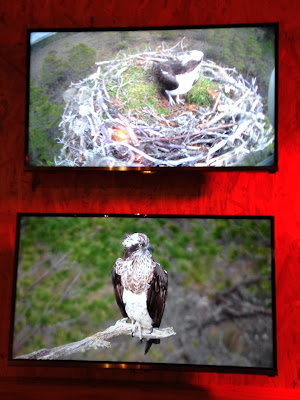 |
Live images of Odin the male osprey on the nest
and EJ the female on a perch by it |
Nuts
I spent a siskin-and-great-spotted-woodpecker-filled hour in the osprey centre hoping to see a crested tit at the feeding station here. I then spent a second hour at the reserve reception, watching coal tits, great tits, blue tits, mallards and dozens of chaffinches at the feeders there. Again no crested tits.
Tits
The young woman in the reception, a naturally skilled communicator with just the right blend of information and interest in what her visitors have to say themselves, suggested that I walk along the shore of Loch Garten, as every time she has done this walk she has seen crested tits. So this I did and I loved these twisted, lichenous pines by the tea-stained loch. Coal tits and chaffinches were everwhere during the hour and more that I walked, and once or twice I heard a wren or a robin. Stopping for the strident, lovely song of a tree pipit I heard to my right a contented trill I have not heard in twenty years, since I lived as a student in sourthern France: the contented trill of a crested tit. I saw neither the pipit nor the tit as I would not bash through the blaeberry undergrowth, disturbing its nesting birds and other wildlife, for the sake of seeing a bird; but I smiled a big smile to know that these lovely birds were there.
Reaching the car park I again heard the trill, in pines right by the road. This time a birding couple was there, so I asked whether they too had heard it. High above their heads they were watching a crested tit pair feeding their newly fledged young. I looked up and at the end of a long day I smiled some more.
This evening I have given a talk at the
Grant Arms on Ecuador, so I have had no time to look for cats tonight. The search begins again tomorrow at three.